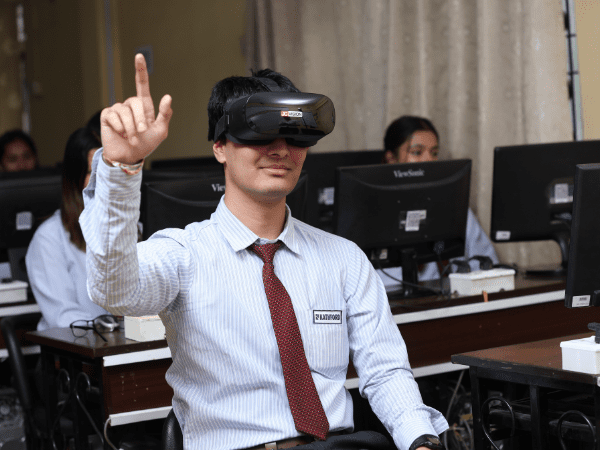
Student using VR camera

BE Computer

Code, Innovate,
& Shape the Future.

Master programming, system design, AI, and emerging technologies to create real impact in a world driven by innovation.
Go Beyond Textbooks
With a Hands-on Curriculum

Where innovation meets engineering to build intelligent systems and shape the digital world.

Student using VR camera

AI-Driven Curriculum

Courses in deep learning, machine learning, and intelligent systems, with hands-on projects through the AI School.

Student Learning with laptops

Secure Systems and Cyber Defense

In-depth modules on cybersecurity, network protocols, and ethical hacking.

Kathford students developing communication and leadership skills during Prep4Profession class

Lab-to-Launch Projects

Embedded Systems, Cloud Computing, and VLSI labs guide students from simulation to implementation.

Team Dot Connect Reciving People's Choice Award

Industry Certifications

Opportunities to earn certifications (AWS, CCNA) and contribute to AI research projects.

Overview of Course

Duration 4 Years, 8 Semesters

Incl, Internship

Location Balkumari

Lalitpur, Metropolitan City

Format Full Time

On Campus

Start date Mangsir- 2082

For Academic year 2082

INNOVATIVE SPECIALIZATION

Curriculum

Our Computer Engineering curriculum is designed to blend strong theoretical foundations with real-world applications. From core subjects like algorithms and computer architecture to emerging areas like AI, IoT, and cybersecurity, you gain hands-on experience through lab work, projects, and industry-relevant training.

AIML

AI & ML

FIFI

Finance & Fintech

SAMA

Sales and Marketing

MAST

Management & Strategy

COMM

Communication & Self Development

Admissions Process At Kathford

Discover how to begin your academic path at Kathford. Admission details and financial guidelines, all in one place.

01

Eligibility & Entrance Exam

01

Eligibility & Entrance Exam

To apply for Engineering at Kathford,

  • you must have completed +2 Science or PCL with a minimum of ‘C’ grade in all subjects.
  • You must pass the IOE (Institute of Engineering) Entrance Examination conducted by Tribhuvan University.

02

College Visit & Priority Form Submission

02

College Visit & Priority Form Submission

After clearing the IOE exam, students must visit Kathford and fill out the College Priority Form (Rs. 500). In this form, students rank their preferred engineering programs (e.g., Civil, Computer, Electronics). The college then evaluates your preferences and publishes the selection result within a week.

03

Program Confirmation & Admission

03

Program Confirmation & Admission

If you are selected for your preferred program, you can proceed with admission. However, if you’re selected for a different program than your first choice, you can visit the college to discuss your options and take necessary steps accordingly. Once you confirm your seat, you complete the formal admission process.

04

Onboarding & Orientation

04

Onboarding & Orientation

Upon admission, students receive a Kathford college email ID and are contacted with essential academic resources, course details, and syllabi. Students are then welcomed through a special orientation session where they meet faculty members, fellow students, and participate in a welcome program.

Eligibility Criteria for BE Computer Engineering

  • Must Clear IoE Entrance Examination
  • Minimum ‘C’ in all subjects in PCL/+2 in Science with Physics and Math or Biology with Extra Math

Our Approach

KATHFORD LEARNING EXPERIENCE MODEL

Empowering students with a holistic, future-ready education that blends academic excellence, professional development, innovation, and personal growth—crafted to shape adaptable, creative, and globally competent graduates.

Student Profile

  • Academic Information
  • Interests
  • Academic Objectives
  • Career Goals and Aspirations
  • Language Proficiency
  • Digital Proficiency
Foundational Literacy
  • Reading Proficiency
  • Writing Skills
  • Comprehension Abilities
  • Subject Specific Literacy
  • Advanced Learning
  • Preparation
Professional Skills
  • Technical Skill
  • Analytical Skill
  • Interpersonal Skill
  • Project Management
Learning and Innovation Skills
  • Creativity, Innovation & Entrepreneurship Skills.
  • Critical Thinking and Problem Solving
  • Communication
  • Collaboration
Life and Career Skills
  • Flexibility and Adaptability
  • Initiative, Self-Direction and Career Planning
  • Social and Cross-Cultural Skills
  • Productivity and Accountability
  • Leadership
  • Active Learning and Curiosity
  • Emotional Intelligence
  • Financial, Civic & Environmental Literacy
  • Global Awareness
STRUCTURE AND LEARNING DOMAIN

Expected Outcomes
What fundamental literacy skills do students need to master for comprehensive knowledge and understanding?
Which specific professional skills should students cultivate to enhance career readiness and achieve success in the workplace?
Which essential life and career skills, including adaptability, leadership, and social responsibility, should be equipped to ensure holistic personal and professional development for students?

  • Navigation of knowledge, skills and abilities
  • Aligning learning objectives with Bloom’s Taxonomy
  • Feedback and loop communication
Academic goals and Strategy
  • Additional Courses and Specialized Trainings
  • Workshops and Practical Skill Development
  • Seminars and Industry Guest Speakers
  • Professional Certifications and Qualifications
  • Industry-Relevant Research Projects
  • Networking Events and Conferences
  • Collaboration with Industry Partners
  • Guided Projects
  • Mentorship
PROFESSIONAL DEVELOPMENT
  • Student Clubs
  • Events
STUDENT EXPERIENCE AND ACTIVITIES
  • Physical Amenities
  • Community and Affiliations
  • Learner Resources
LEARNING ENVIRONMENT
PROCESS AND PILLARS

Processes designed to achieve the outcomes
Processes and pillars encompass the essential actions and foundations required for holistic student development, aligning with academic goals, professional readiness, enriched experiences, and a conducive learning environment. These form the integral framework guiding the comprehensive approach toward fostering well-rounded individuals prepared for the challenges of the future.

LEARNING EXPERIENCE MODEL CANVAS

Student Profile

  • Academic Information
  • Interests
  • Academic Objectives
  • Career Goals and Aspirations
  • Language Proficiency
  • Digital Proficiency
STRUCTURE AND LEARNING DOMAIN

Expected Outcomes
What fundamental literacy skills do students need to master for comprehensive knowledge and understanding?
Which specific professional skills should students cultivate to enhance career readiness and achieve success in the workplace?
Which essential life and career skills, including adaptability, leadership, and social responsibility, should be equipped to ensure holistic personal and professional development for students?

Foundational Literacy
  • Reading Proficiency
  • Writing Skills
  • Comprehension Abilities
  • Subject Specific Literacy
  • Advanced Learning
  • Preparation
Professional Skills
  • Technical Skill
  • Analytical Skill
  • Interpersonal Skill
  • Project Management
Learning and Innovation Skills
  • Creativity, Innovation & Entrepreneurship Skills.
  • Critical Thinking and Problem Solving
  • Communication
  • Collaboration
Life and Career Skills
  • Flexibility and Adaptability
  • Initiative, Self-Direction and Career Planning
  • Social and Cross-Cultural Skills
  • Productivity and Accountability
  • Leadership
  • Active Learning and Curiosity
  • Emotional Intelligence
  • Financial, Civic & Environmental Literacy
  • Global Awareness
PROCESS AND PILLARS

Processes designed to achieve the outcomes
Processes and pillars encompass the essential actions and foundations required for holistic student development, aligning with academic goals, professional readiness, enriched experiences, and a conducive learning environment. These form the integral framework guiding the comprehensive approach toward fostering well-rounded individuals prepared for the challenges of the future.

  • Navigation of knowledge, skills and abilities
  • Aligning learning objectives with Bloom’s Taxonomy
  • Feedback and loop communication
Academic goals and Strategy
  • Additional Courses and Specialized Trainings
  • Workshops and Practical Skill Development
  • Seminars and Industry Guest Speakers
  • Professional Certifications and Qualifications
  • Industry-Relevant Research Projects
  • Networking Events and Conferences
  • Collaboration with Industry Partners
  • Guided Projects
  • Mentorship
PROFESSIONAL DEVELOPMENT
  • Student Clubs
  • Events
STUDENT EXPERIENCE AND ACTIVITIES
  • Physical Amenities
  • Community and Affiliations
  • Learner Resources
LEARNING ENVIRONMENT

The Kathford Experience

Ashish Thapa Receives the Prestigious Shivaraj Pant Memorial Award

Kathford student Ashish Thapa receiving Shivraj Pant Memorial Award for academic excellence

Course Overview

Master Concepts Inside And Outside the Classroom

In Class

Engineering Mathematics I

Differentiation & integration

Differential equations

Matrices & linear equations

Computer Programming

Basics of C programming

Arrays, pointers, functions

File handling & structures

Engineering Drawing I

Orthographic & isometric views

Projection of lines & planes

Sectional views & dimensioning

Engineering Physics

Mechanics & thermodynamics

Waves & optics

Modern physics basics

Applied Mechanics

Statics & dynamics

Friction & centroids

Moment of inertia

Basic Electrical Engineering

DC & AC circuits

Transformers & basic machines

Kirchhoff’s laws & network theorems

Out Class

Basic Electronics Workshop

Hands-on learning of circuits and components to build and troubleshoot electronic devices.

Student from Department of BEX using Soldering Pen

Arduino Beginner Bootcamp

Interactive training to learn microcontroller programming and create simple embedded systems.

Student designing electrical circuit
In Class

Engineering Mathematics II

Complex numbers

Laplace & Fourier transforms

Vector calculus

Engineering Drawing II

Surface development

Intersections of solids

Machine & assembly drawings

Basic Electronics Engineering

Diodes & transistors

Logic gates

Amplifiers & number systems

Engineering Chemistry

Atomic structure

Polymers & water treatment

Electrochemistry & corrosion

Thermodynamics & Heat Transfer

Laws of thermodynamics

Heat transfer modes

Thermodynamic cycles

Workshop Technology

Fitting & welding

Machine tools

Carpentry & sheet metal

Out Class

C Graphics Programming Workshop

Learn the basics of creating 2D graphics and animations using the C language.

Kathford Student Learning

Linux & Git Essentials

Practical session on Linux basics and Git/GitHub for effective project collaboration.

Speaker Presenting About Design Elements and Principles
In Class

Engineering Mathematics III

Probability & statistics

Numerical methods

Z-transforms

Object Oriented Programming

Classes & objects

Inheritance & polymorphism

File & exception handling

Electric Circuit Theory

Network theorems

AC/DC circuit analysis

Transient response

Theory of Computation

Automata & grammars

Turing machines

Pushdown automata

Electronics Devices and Circuit

Diodes & transistors

Amplifier circuits

Operational amplifiers

Digital Logic

Boolean algebra & gates

Flip-flops & counters

Combinational & sequential circuits

Electromagnetics

Maxwell’s equations

Electric & magnetic fields

Wave propagation

Out Class

Raspberry Pi for IoT

Build IoT projects while learning Raspberry Pi setup, configuration, and Python programming.

Student creating a electrical circuit using breadboard , resistors, battery, capacitor inductor

PCB Design & Fabrication

Create your own printed circuit boards using industry tools and hands-on fabrication processes.

Students operating lab tools
In Class

Electrical Machines

Transformers

DC & AC machines

Motors & generators

Numerical Method

Root finding

Interpolation

Engineering Chemistry

Applied Mathematics

Complex variables

PDEs

Fourier & Laplace transforms

Instrumentation I

Sensors & transducers

Signal conditioning

Measurements

Data Structure and Algorithm

Arrays, stacks, queues

Trees & graphs

Sorting & searching

Microprocessor

8085/8086 architecture

Memory & I/O

Assembly coding

Discrete Structure

Logic & sets

Graphs & trees

Combinatorics

Out Class

Python for Computing and Data Analysis

Explore Python basics with data visualization and automation techniques.

Internal Hackathon Challenge

Collaborate to solve real-world problems and build functional prototypes in a time-bound event.

Student Learning with laptops
In Class

Communication English

Technical writing

Presentation skills

Report writing

Software Engineering

SDLC

Requirement & design

Testing

Probability and Statistics

Probability

Distributions

Hypothesis testing

Instrumentation II

Sensors

Signal conditioning

Digital systems

Computer Graphics

2D/3D transforms

Clipping

Rendering

Data Communication

Transmission media

Error control

Protocols

Computer Organization and Architecture

CPU & memory

Instruction cycle

Pipelining

Out Class

Blockchain & Cryptocurrency Fundamentals

Learn the basics of blockchain technology and experiment with smart contracts and wallets.

3d-cryptocurrency-rendering-design-

External Tech Competitions

Represent the college in national-level coding, robotics, and innovation competitions.

Team Dot Connect Reciving People's Choice Award
In Class

Engineering Economics

Cost analysis

Depreciation & inflation

Project evaluation

Embedded System

Microcontrollers

Real-time systems

I/O interfacing

Artificial Intelligence

Search algorithms

Knowledge representation

Expert systems

Database Management System

Normalization

Transactions & indexing

SQL & relational models

Object Oriented Analysis and Design

UML diagrams

Use cases & class design

System modeling

Operating System

Process & thread management

Memory & file systems

Scheduling & synchronization

Minor Project

Problem identification

System design & development

Documentation & presentation

Out Class

Advanced Networking and CCNA Prep

Master advanced networking skills through practical labs and CCNA certification preparation.

IT Technician

RoboKath Bot Challenge

Design and build robots to compete in technical challenges and automation tasks.

Participation in Orbit 2.0 event
In Class

Project Management

Project planning & scheduling

Risk management

Cost estimation & control

Computer Network

Network models (OSI, TCP/IP)

Routing & switching

Network security

Distributed System

Distributed architecture

Communication & synchronization

Fault tolerance

Digital Signal Analysis and Processing

Discrete signals & systems

Fourier & Z-transforms

Filters & signal analysis

Organization and Management

Management principles

Organizational structure

Leadership & motivation

Energy, Environment and Society

Environmental issues

Sustainable development

Energy sources & conservation

Elective I

Based on chosen topic (e.g., Machine Learning, IoT, etc.)

Specialized concepts

Practical applications

Project I

Proposal & system design

Initial development

Progress presentation

Out Class

Deep Learning Basics

Get hands-on with AI frameworks like TensorFlow and PyTorch for deep learning applications.

Kathford's Dot Connect Team participating in an event

Digital Marketing & SEO

Learn digital marketing strategies and SEO techniques to grow an online presence.

Teachers engaging in teaching event
In Class

Professional Practice

Ethics & professionalism

Workplace communication

Legal aspects & IT policies

Information Systems

System components & types

Information system development

ERP & decision support systems

Simulation and Modelling

System modeling techniques

Queuing & inventory models

Simulation tools & analysis

Internet and Intranet

Web technologies & protocols

Network security & intranet setup

Server-side & client-side scripting

Elective II

Advanced concepts

Tools & real-world application

Elective III

Another specialized subject

Technical depth

Case studies or implementations

Project II

Final development & testing

Report writing

Final defense & presentation

Out Class

Career Launchpad Workshop

Prepare for the job market with resume building, interview training, and career planning sessions.

Presentation on Large Langauge Models

Final Year Industry Internship

Gain practical exposure by working on real-world engineering projects in industry settings.

Students actively engaging in a workshop related to computer science
Experience engineering beyond textbooks through real-world events and exposure.

Course Roster

Term
Course Name Professor Concentration Credit Hour
Digital Logic
Praches Acharya
Prashant Bashyal
Digital Logic Design, Computer Architecture, Embedded Systems
48 hours
Electric Circuits and Machines
Mr Manik Arora
Raju Shah
Raju Shrestha
Electrical Engineering Fundamentals, Power Systems, Control Systems
48 hours
Electronics Devices and Circuit
Chaitya Shova Shakya
Analog Electronics, Semiconductor Devices, Circuit Analysis
48 hours
Engineering Chemistry
Anant Babu Marahatta
Materials Science, Environmental Chemistry, Industrial Chemistry
48 hours
Engineering Mathematics II
Arjan Kumar Sunar
Vector Calculus, Differential Equations, Linear Algebra
48 hours
Object Oriented Programming
Bishon Lamichhane
Software Development, Programming Paradigms, Application Design
48 hours
Data Communication
Bimal Aryal
Computer Networks, Network Protocols, Communication Systems
48 hours
Data Structure and Algorithm
Prakash Pandey
Suman Shrestha
Algorithm Design, Computational Complexity, Software Development
48 hours
Electromagnetics
Narayan Adhikari
Prashant Bashyal
Field Theory, Wireless Communication, Microwave Engineering
48 hours
Instrumentation
Sochindra Kumar Ray
Saban Kumar KC
Sensors and Transducers, Measurement Systems, Control Engineering
48 hours
Numerical Methods
Kishor Adhikari
Computational Mathematics, Applied Mathematics, Scientific Computing
48 hours
Operating System
Jaydeep Shah
System Programming, Process Management, Memory Management
48 hours
Communication English
Prabeen Kumar Awasthi
Technical Communication, Professional Writing, Interpersonal Skills
48 hours
Computer Graphics
Sharad Chandra Joshi
Visualization, Image Processing, Animation Techniques
48 hours
Computer Organization and Architecture
Subash Sharma
Jaydeep Shah
Processor Design, Memory Systems, Instruction Set Architecture
48 hours
Data Communication
Bimal Aryal
Network Protocols, Wireless Communication, Network Security
48 hours
Instrumentation II
Saban Kumar KC
Advanced Measurement Techniques, Process Control, Signal Conditioning
48 hours
Probability and Statistics
Merina Sthapit
Statistical Analysis, Stochastic Processes, Data Analytics
48 hours
Software Engineering
Prabin Kumar Jha
Software Development Life Cycle, Project Management, Quality Assurance
48 hours
Computer Networks
Sujan Khyaju
Network Security, Wireless Networks, Network Protocols
48 hours
Digital Signal Analysis and Processing
Suresh Prasad Sah
Bimal Aryal
Signal Filtering, Image Processing, Speech Recognition
48 hours
Distributed System
Suman Shrestha
Cloud Computing, Distributed Algorithms, Networked Systems
48 hours
Elective I Enterprise Computing
Dipak Prasad Poudel
Enterprise Architecture, Cloud Solutions, Business Process Management
48 hours
Energy, Environment and Society
Roshan Pandey
Renewable Energy, Environmental Impact Assessment, Sustainable Development
48 hours
Organization and Management
Amar Joshi
Project Management, Leadership Skills, Business Communication
48 hours
Project Management
Rajib Kumar Hyoju
Risk Management, Resource Planning, Quality Control
48 hours

Award and achievement

Celebrating Excellence: Recognizing Student Achievements and Milestones!

Meet The Masters

Masters Who Make Learning Lit.

IMG 5905 scaled
Er. Chaitya Shova Shakya

Assistant Professor, Department Head

Department of Computer and Electronics, Communication and Information Engineering.

Screenshot 2026 06 26 at 11.40.20
Er. Prabin Kumar Jha

Assistant Professor, Deputy Head of Department, Examination Coordinator:

Department of Computer and Electronics, Communication and Information Engineering

Mr. Bimal AryalLecturer, Computer/Electronics Communication and Information Engineering
Er. Bimal Aryal

Assistant Professor,

Department of Computer and Electronics Communication and Information Engineering

Screenshot 2026 06 26 at 10.40.25
Er. Jaydeep Shah

Assistant Professor,

Department of Computer and Electronics, Communication and Information Engineering

Screenshot 2026 06 26 at 10.41.08
Er. Krishna Gautam

Assistant Professor,

Department of Computer and Electronics, Communication and Information Engineering

Screenshot 2026 06 26 at 10.53.11
Rabi Kumar KC

Lab Assistant

Screenshot 2026 06 26 at 11.25.15
Milan Shrestha

Lab Assistant,

Department of Computer and Electronics, Communication and Information Engineering

Screenshot 2026 06 26 at 10.40.47
Miss Juli Kumari Singh

Department Secretary,

Department of Computer and Electronics Communication and Information Engineering

Employer Network

Connecting students with top employers for a brighter future.

Unlock Your Potential with US!

Prepare for a Brighter Tomorrow

Curious? Let’s Chat!

Loading please wait...