


Engineering Courses in Nepal: 12 Brutally Honest Truths Every Student Should Know

Choosing engineering courses in Nepal is one of the biggest academic decisions many students make after +2 Science. Every year, thousands of Nepali students prepare for entrance exams believing engineering is either impossibly difficult or automatically prestigious. The truth lies somewhere in between. The real difficulty of engineering depends on the branch you choose, your interest level, your study habits, your mathematical foundation, and your willingness to adapt to pressure. In this article, we will honestly explain the reality of engineering education in Nepal, including BE Civil Engineering Nepal, BE Computer Engineering Nepal, electronics engineering Nepal, engineering entrance exam Nepal, and engineering student life Nepal so students can make informed choices instead of emotional decisions.
Table of Contents
- Understanding the Real Nature of Engineering Courses in Nepal
- Why Engineering Entrance Exam Nepal Feels Difficult Initially
- BE Civil Engineering Nepal Difficulty Explained Honestly
- BE Computer Engineering Nepal Difficulty and Coding Pressure
- Electronics Engineering Nepal and Real Challenges in Engineering Courses in Nepal
- Mathematics and Physics in Engineering Courses in Nepal
- Time Management Problems in Engineering Courses in Nepal
- Practical Labs and Project Pressure in Engineering Courses in Nepal
- Mental Pressure Inside Engineering Courses in Nepal
- Which Engineering Branch Is Actually Hardest in Nepal?
- How Good Colleges Improve Engineering Courses in Nepal
- Is Engineering Worth It? Career Reality After Engineering Courses in Nepal
Part 1: Understanding the Real Nature of Engineering Courses in Nepal
Many students enter engineering with unrealistic expectations. Some believe engineering is only for “genius” students, while others think joining an engineering college automatically guarantees a successful career. The reality of engineering courses in Nepal is far more balanced. Engineering is difficult, but not impossible. It is demanding, but manageable for students who consistently work and stay disciplined.
One of the biggest misconceptions among Nepali students is that engineering difficulty comes only from mathematics. In reality, engineering challenges come from multiple directions at the same time. Students must manage theoretical subjects, practical labs, assignments, presentations, projects, viva examinations, internal assessments, and semester pressure together. A student who was a topper in +2 may suddenly struggle because engineering requires long-term consistency rather than short-term memorization.
The first year becomes especially difficult because students are adjusting to a completely different academic culture. In school and +2, many students study mainly before examinations. Engineering does not allow that approach for long. Concepts build on top of previous concepts. If a student ignores Engineering Mathematics in the first semester, later subjects become much harder. This is why many students experience academic shock during the transition period.
Another honest reality is that different engineering branches have different kinds of difficulty. Civil Engineering involves design calculations, surveying, structural analysis, and field-based understanding. Computer Engineering requires logic building, coding practice, algorithms, and continuous technological adaptation. Electronics Engineering combines hardware complexity with mathematical analysis and communication systems. None of them are “easy.” They are simply difficult in different ways.
At institutions like Kathford International College, the academic approach increasingly focuses on practical and industry-oriented learning through frameworks like the Kathford Learning Experience Model (KLEM), which emphasizes analytical thinking, communication, teamwork, project-based learning, and hands-on application rather than rote memorization. This type of structured learning environment helps students manage engineering difficulty more effectively because they learn through practical engagement instead of fear-based studying.
A realistic example can be seen in many first-year engineering students in Kathmandu. A student who scored excellent marks in NEB may struggle initially because engineering requires problem-solving endurance. Students often spend hours debugging one programming problem or solving one structural calculation. The difficulty comes from persistence, not only intelligence.
The most important truth is this: engineering difficulty becomes manageable when students genuinely understand why they chose the field. Students who join engineering only because of family pressure usually struggle mentally much more than students who are personally interested in solving technical problems.
The real nature of engineering is therefore not about being naturally brilliant. It is about developing consistency, resilience, and the willingness to keep learning even when things become uncomfortable.
Part 2: Why Engineering Entrance Exam Nepal Feels Difficult Initially
For many students, the first major challenge begins before college itself through the engineering entrance exam Nepal system. Entrance preparation creates fear because students suddenly compete with thousands of highly motivated students from across the country. However, the difficulty is often psychological as much as academic.
The entrance exam tests not only knowledge but also speed, time management, and conceptual understanding. Students who relied mainly on memorization during +2 often struggle because entrance questions demand application of concepts rather than textbook repetition. Physics, numericals, advanced mathematics, and chemistry problem-solving become major barriers for many students.
One honest reason entrance preparation feels difficult is inconsistency in Nepal’s school-level education quality. Students from strong academic backgrounds in Kathmandu may have access to coaching centers, digital resources, and competitive peer groups. Meanwhile, many students from outside the valley must adjust rapidly to a much more competitive environment. This adjustment period creates anxiety and self-doubt.
The pressure from families also increases the emotional burden. In Nepal, engineering still carries social prestige. Many parents proudly tell relatives their child is preparing for IOE or engineering admission. This social expectation creates additional stress for students who fear disappointing their families.
However, the difficulty of entrance preparation also teaches valuable lessons early. Students learn discipline, study scheduling, revision techniques, and mental endurance. Those habits later become extremely useful during engineering semesters.
Institutions like Kathford increasingly promote practical learning and skill development alongside theoretical preparation. Their academic philosophy emphasizes student-centered learning, critical thinking, adaptability, and experiential education rather than only examination performance. This matters because engineering success depends far more on long-term learning ability than one entrance score.
A realistic example is a student from Pokhara preparing for the IOE entrance while balancing family expectations and financial limitations. Initially, the student may feel overwhelmed competing with students attending expensive entrance institutes in Kathmandu. But over time, disciplined daily practice and conceptual learning can close that gap significantly. Many successful engineers in Nepal were not entrance toppers. They simply stayed consistent.
Another honest point is that entrance difficulty often scares students more than necessary. Students hear seniors discussing “backlogs,” “pressure,” and “hard subjects,” creating fear before classes even begin. While engineering is genuinely challenging, fear exaggerates the difficulty.
The entrance exam is therefore less about proving intelligence and more about proving readiness for disciplined technical education. Students who approach preparation systematically usually perform much better emotionally and academically than students who study only under panic pressure.
Part 3: BE Civil Engineering Nepal Difficulty Explained Honestly
Among all engineering courses in Nepal, Civil Engineering is often misunderstood. Many students assume Civil Engineering is easier because it appears more “traditional” compared to computer-related fields. In reality, BE Civil Engineering Nepal can become extremely demanding because it combines mathematical analysis, technical drawing, fieldwork, surveying, structural design, hydraulics, transportation systems, and construction management all within one degree.
The first challenge Civil Engineering students face is volume. The syllabus is broad and highly layered. Students move from foundational subjects like Engineering Drawing and Applied Mechanics into advanced structural analysis, geotechnical engineering, water resources, transportation engineering, and environmental engineering. Each subject requires both conceptual understanding and practical application. According to Kathford’s Civil Engineering learning model, students are expected to develop analytical reasoning, design capabilities, software proficiency, fieldwork experience, and problem-solving abilities simultaneously.
One particularly difficult aspect is structural analysis. Many students struggle because the subject demands patience and accuracy. A single calculation mistake can affect an entire solution. Unlike school-level mathematics where answers may come quickly, structural calculations often require multiple interconnected steps. Students who lack concentration habits usually find this frustrating.
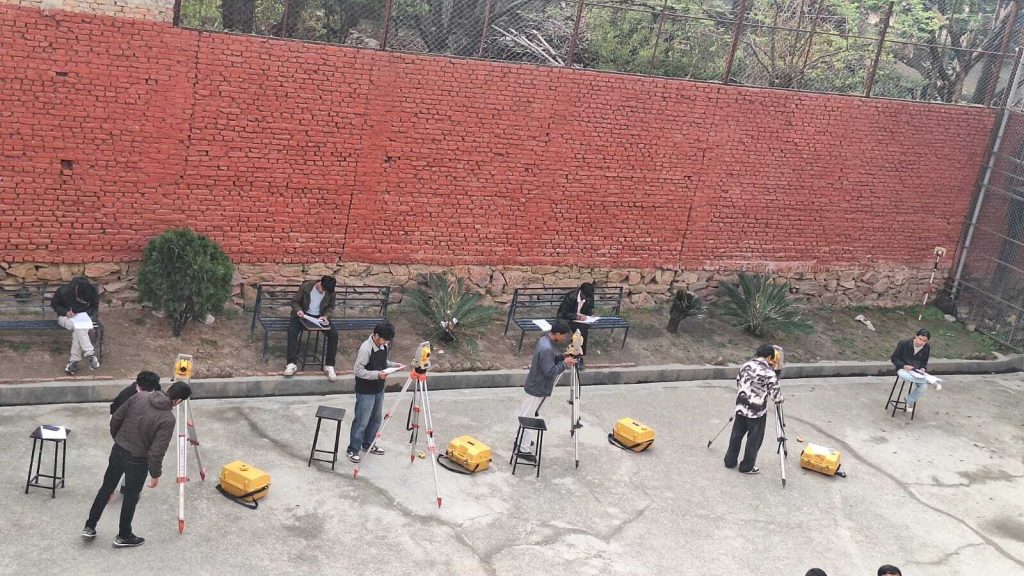
Surveying is another area students underestimate. In Nepal, Civil Engineering students often perform outdoor practical work under difficult weather conditions. They may spend hours carrying equipment, taking field measurements, preparing contour maps, and correcting technical errors. The difficulty is not only academic but also physical and mental.
Hydraulics and fluid mechanics also become major obstacles for many students because they combine physics concepts with engineering applications. Students who memorize formulas without understanding physical behavior often struggle badly in these subjects.
Another honest reality is project pressure. Civil Engineering students usually handle reports, site visits, group projects, AutoCAD drawings, and design assignments at the same time. During submission periods, sleep schedules become highly irregular. Students commonly spend late nights completing design sheets or correcting surveying calculations before deadlines.
However, Civil Engineering also rewards practical learners. Students who actively participate in labs, fieldwork, and project discussions usually perform better than students who only memorize theory. Kathford’s approach toward hands-on civil engineering education through labs, project-based learning, AI-integrated civil technologies, GIS tools, and smart infrastructure exposure reflects this practical orientation.
A realistic Nepali example is a student who enters Civil Engineering thinking it is mainly about building roads and bridges. After joining college, the student realizes the field involves environmental impact analysis, construction economics, geotechnical calculations, software modeling, transportation systems, and continuous technical reporting. The workload feels overwhelming initially because the profession itself is multidisciplinary.
The difficulty of Civil Engineering therefore comes from balance. Students must combine technical precision, practical understanding, teamwork, and long-term consistency. Those who stay engaged with real-world applications usually adapt better than those studying only for examinations.
For students exploring programs, it is useful to review details about BE Civil Engineering at Kathford, where practical exposure and modern engineering integration are emphasized alongside theoretical learning.
Part 4: BE Computer Engineering Nepal Difficulty and Coding Pressure
The popularity of BE Computer Engineering Nepal has increased rapidly because students associate it with software careers, AI, cybersecurity, and global tech opportunities. However, many students enter Computer Engineering without fully understanding its actual difficulty level. The hardest part of Computer Engineering is not memorization. It is continuous logical thinking and problem-solving endurance.
Computer Engineering students quickly discover that coding is very different from watching programming tutorials online. Writing code independently requires analytical thinking, debugging patience, algorithmic understanding, and the ability to solve problems step by step. A student may spend hours trying to fix a single logical error in a program. This constant mental engagement becomes exhausting for students who expect quick results.
According to Kathford’s BCT learning framework, students are expected to build competence across software development, networking, cybersecurity, operating systems, hardware architecture, databases, machine learning tools, cloud systems, and project management simultaneously. This breadth is one reason Computer Engineering becomes mentally intense.
One major difficulty is rapid technological change. Civil Engineering concepts may remain stable for decades, but Computer Engineering evolves constantly. Students must adapt to new programming frameworks, development tools, cloud platforms, and AI systems continuously. Many students feel overwhelmed because learning never truly stops in technology fields.
The workload also becomes highly project-oriented. Unlike subjects where students can simply prepare before exams, programming skill improves only through repeated practice. Students who avoid coding for several weeks often lose confidence quickly. Engineering semesters become stressful because students simultaneously manage coding labs, theoretical exams, mini-projects, and practical assessments.
Data structures and algorithms are especially difficult for many Nepali students because these subjects require deep logical reasoning. Students who performed well through memorization in school suddenly struggle when asked to optimize algorithms or solve unseen logical problems.
At the same time, Computer Engineering offers highly rewarding learning experiences for curious students. Kathford’s integration of AI-driven curriculum, cloud systems, cybersecurity, embedded systems, and innovation-focused labs reflects how modern Computer Engineering education increasingly combines theory with real-world experimentation. The inclusion of AI and innovation labs, machine learning tools, cloud computing exposure, and collaborative technical projects further prepares students for evolving industry demands.
A realistic example is a first-year student who joins Computer Engineering mainly because relatives said “IT has a future.” Initially, the student enjoys basic programming. But by the third semester, advanced algorithms, networking concepts, operating systems, and project deadlines create serious academic pressure. Students who genuinely enjoy building systems and solving technical puzzles usually survive this phase much better than students motivated only by salary expectations.
Another honest issue is comparison culture. In Nepali engineering colleges, students constantly compare coding skills, internship opportunities, GitHub projects, and placement prospects. This creates mental stress even among capable students.
The real difficulty of Computer Engineering therefore comes from intellectual persistence. Students must continuously think, build, fail, debug, improve, and repeat. It rewards curiosity and consistency far more than natural talent alone.
Students interested in exploring the field can review BE Computer Engineering at Kathford to understand how modern engineering education integrates AI, cybersecurity, cloud systems, and hands-on technical learning.
Part 5: Electronics Engineering Nepal and Real Challenges in Engineering Courses in Nepal
Among major engineering branches, electronics engineering Nepal is probably the most underestimated in terms of difficulty. Many students choose Electronics and Communication Engineering without fully understanding how mathematically and conceptually dense the course actually is.
Electronics Engineering combines hardware systems, communication technologies, signal processing, networking, embedded systems, microcontrollers, circuit theory, and programming into one demanding curriculum. Unlike Computer Engineering, where students can visually see outputs through software applications, Electronics often involves abstract signal behavior and invisible electronic processes. This abstraction makes the learning curve much steeper for many students.
One of the biggest struggles comes from circuit analysis. Students must understand voltage behavior, current flow, semiconductor operations, digital logic systems, and communication protocols at a deep conceptual level. Memorizing formulas rarely works because examinations frequently test analytical application rather than direct repetition.
Signal processing becomes another major obstacle. Students often describe Digital Signal Processing (DSP) as one of the hardest subjects because it requires strong mathematics, frequency analysis, and conceptual visualization. Students weak in calculus and transforms usually face serious academic difficulty here.
Kathford’s BEI framework explains that students are expected to master digital systems, communication networks, embedded AI systems, wireless communication, cybersecurity principles, IoT integration, and hardware-software design together. This interdisciplinary structure is academically powerful but also mentally demanding.
Labs create additional pressure. Electronics students spend long hours troubleshooting circuits, testing signals, debugging hardware behavior, and writing technical reports. Unlike theoretical mistakes that remain on paper, practical errors in labs become immediately visible when circuits fail to function. This trial-and-error learning process can frustrate impatient students.
However, Electronics Engineering also develops exceptional analytical disciplines. Students gradually learn precision, systems thinking, and engineering patience. These skills become highly valuable in industries involving telecommunications, embedded systems, automation, robotics, and AI hardware integration.
Kathford’s modern emphasis on AI-powered signal processing, IoT systems, FPGA projects, wireless technologies, and AI-integrated electronics education reflects how the field is evolving beyond traditional communication engineering. Students are increasingly exposed to intelligent systems and interdisciplinary technological innovation rather than isolated hardware theory alone.
A realistic Nepali example is a student who enters Electronics Engineering because their IOE rank did not allow Computer Engineering admission. Initially, the student feels disappointed. But later, through embedded systems projects and IoT experimentation, the student discovers genuine interest in automation and intelligent hardware systems. This happens more often than people realize.
The honest truth is that Electronics Engineering is difficult because it requires both conceptual depth and technical precision simultaneously. Students who remain curious and patient usually adapt over time, while students seeking shortcut-based studying often struggle heavily.
Part 6: Mathematics and Physics in Engineering Courses in Nepal
No matter which branch students choose, Mathematics and Physics remain the true backbone of engineering student life in Nepal. Many engineering difficulties actually come from weak foundations in these subjects rather than the engineering branch itself.
Engineering Mathematics becomes especially challenging because it moves beyond school-level problem-solving into abstract applications. Calculus, differential equations, matrices, Laplace transforms, probability, and numerical methods appear across multiple engineering subjects. Students who avoided conceptual understanding in +2 often experience shock when these topics become unavoidable tools rather than isolated chapters.
Physics creates similar problems. Engineering students must apply physical principles to real systems instead of memorizing definitions. Concepts like force equilibrium, thermodynamics, electrical behavior, fluid mechanics, wave systems, and energy transfer continuously reappear throughout semesters.
One honest issue in Nepal is that many students focus heavily on entrance preparation tricks rather than genuine conceptual learning. They solve repeated objective questions without deeply understanding why formulas work. This approach may help temporarily in entrance exams but creates major problems later during engineering courses.
Kathford’s academic philosophy strongly emphasizes foundational literacy, analytical reasoning, problem-solving, experiential learning, and critical thinking because technical education depends heavily on strong conceptual foundations. The KLEM framework further highlights foundational literacy and advanced learning preparation as core pillars supporting engineering competence.
A common example is a first-year engineering student struggling in Engineering Mathematics while simultaneously managing programming, drawing, or circuit analysis subjects. The student may begin doubting their intelligence, when in reality the issue is foundational inconsistency developed over many years. Once students improve conceptual understanding gradually, confidence often returns.
Another reality is language adjustment. Many Nepali students studied partly in Nepali-medium environments before entering English-dominant engineering classrooms. Understanding technical terminology in mathematics and physics therefore becomes an additional challenge during early semesters.
Despite all this, students slowly adapt through repetition and exposure. Mathematics and Physics stop feeling like isolated school subjects and start becoming practical engineering tools. This transition is difficult but essential.
The difficulty of engineering therefore cannot be separated from mathematical and physical reasoning ability. Students who invest time strengthening these foundations early usually experience far less stress later in advanced semesters.
Part 7: Time Management Problems in Engineering Courses in Nepal
One of the biggest hidden difficulties in engineering courses in Nepal is not intelligence, but time management. Many students enter engineering believing they can study the same way they did during school or +2. They quickly realize engineering demands continuous balancing of classes, assignments, practical work, projects, presentations, group discussions, internal exams, and personal responsibilities all at once.
The workload becomes especially overwhelming during mid-semester and final submission periods. Students often face multiple deadlines within the same week. A Civil Engineering student may simultaneously prepare surveying reports, structural design sheets, and lab files while studying for theory examinations. A Computer Engineering student may handle coding projects, debugging sessions, presentations, and mathematics assignments together. Electronics students often spend late nights correcting circuit outputs and simulation results before lab evaluations.
The difficulty increases because engineering work cannot always be completed quickly. Some assignments require extended concentration. Coding projects may fail unexpectedly. Survey calculations may need correction. Circuit designs may not function properly during testing. Students cannot simply “memorize and finish.” Many tasks require patience and repeated effort.
In Nepal, another factor affecting engineering student life is commuting pressure. Many students travel long distances daily in Kathmandu traffic. After spending hours in buses or microbuses, students still need to complete technical assignments and prepare for practical sessions. This physical exhaustion quietly affects academic performance.
Kathford’s learning philosophy places strong emphasis on project-based learning, collaboration, communication, and practical engagement because real engineering work depends heavily on managing multiple responsibilities effectively. The institution’s structured learning environment encourages students to develop organizational habits gradually instead of depending entirely on last-minute preparation.
Another honest issue is the procrastination culture among engineering students. Many students delay assignments believing they can complete everything near deadlines. This approach becomes dangerous in engineering because technical work usually takes longer than expected. A programming error that appears simple may consume six hours. A design drawing may require multiple corrections. A group project may stall because team members work at different speeds.
A realistic example can be seen during engineering project weeks in Kathmandu colleges. Students often sleep very little while trying to finish reports, presentations, and prototypes simultaneously. Some students even begin doubting whether they are “capable enough” for engineering, when the actual problem is poor scheduling and unrealistic workload management.
Social expectations also complicate things. Nepali families may not fully understand the time demands of engineering education. Parents sometimes compare engineering students to relatives studying less technically demanding courses, expecting similar routines and availability. Students therefore face pressure both academically and personally.
The honest reality is that engineering rewards students who build sustainable routines. Students who consistently revise concepts, attend labs seriously, and complete work gradually usually experience much less stress than students who rely on panic studying. Engineering is difficult partly because it forces students to develop discipline, planning ability, and long-term consistency.
Part 8: Practical Labs and Project Pressure in Engineering Courses in Nepal
Many students assume engineering difficulty comes mainly from theory examinations. In reality, practical labs and projects often become even more stressful. Across all branches of engineering, hands-on work exposes whether students truly understand concepts or only memorized textbook content.
In Civil Engineering, practical difficulty appears through surveying camps, structural modeling, material testing, AutoCAD work, and field-based analysis. Students spend hours performing measurements, preparing reports, and correcting technical details. The physical nature of some activities adds another layer of exhaustion.
In Computer Engineering, practical pressure comes through coding assignments, software projects, debugging, database implementation, networking configuration, and system design. Students may spend entire nights trying to fix one persistent error. Unlike theory exams where preparation ends after the test, programming projects often continue evolving until final submission.
Electronics Engineering creates particularly intense practical challenges because hardware systems frequently behave unpredictably. Students may carefully design circuits only to discover small connection issues causing complete failure. Troubleshooting requires patience, technical accuracy, and emotional control under pressure.
Kathford’s academic approach strongly emphasizes experiential learning, project-based work, innovation, and practical implementation because engineering competence develops through application rather than memorization alone. The institution’s AI and Innovation Lab proposal further highlights interdisciplinary project work involving AI systems, robotics, IoT devices, collaborative development, and real-world prototyping.
This practical orientation is valuable but also demanding. Students cannot hide weak understanding during lab sessions. If a bridge design fails, code crashes, or circuit does not function, the problem becomes immediately visible. Practical work therefore creates emotional pressure that theory examinations sometimes do not.
Group projects introduce another challenge: teamwork imbalance. In many Nepali engineering colleges, some students contribute heavily while others participate minimally. Managing communication, deadlines, and unequal effort becomes stressful, especially when project grades affect final evaluation.
However, practical learning also produces the most meaningful growth. Students gradually stop seeing engineering as isolated formulas and begin understanding how technical systems function in the real world. A Civil Engineering student observing construction processes on-site gains far deeper understanding than from classroom notes alone. A Computer Engineering student who successfully deploys a software system gains confidence impossible to achieve through theory memorization.
Kathford’s emphasis on internships, workshops, guided projects, mentorship, industry collaboration, and AI-integrated learning environments reflects how modern engineering education increasingly prioritizes real-world readiness.
A realistic Nepali example is a final-year student struggling during capstone project season. The student may simultaneously manage technical implementation, documentation, presentations, and internship applications. Sleep schedules become irregular, frustration levels rise, and confidence fluctuates daily. Yet after successfully completing the project, the student often realizes how much practical growth occurred during that difficult period.
The truth is that engineering projects feel stressful precisely because they simulate real professional challenges. Students are not simply studying engineering. They are gradually learning how engineers actually think, collaborate, troubleshoot, and solve problems under pressure.
Part 9: Mental Pressure Inside Engineering Courses in Nepal
One topic students rarely discuss honestly before joining engineering is mental pressure. Behind the reputation of engineering student life Nepal lies a reality filled with stress, self-doubt, burnout, and fear of academic failure. Many students struggle silently because engineering culture sometimes normalizes exhaustion instead of addressing it properly.
Backlogs become one of the biggest emotional burdens. In Nepal, students often hear frightening stories about seniors carrying multiple back papers for years. This creates intense anxiety, especially during difficult semesters. A student who fails one subject may begin questioning their intelligence entirely, even though backlogs are extremely common in engineering education.
The problem becomes worse because many students compare themselves constantly. Social media, class rankings, coding achievements, internships, and academic performance create an unhealthy comparison environment. Students may feel left behind even when they are progressing normally.
Another major issue is identity pressure. In Nepal, engineering students are often labeled as “smart students” by relatives and society. This reputation creates fear of failure because students worry about disappointing family expectations. Some students continue studying branches they dislike simply because changing paths feels socially embarrassing.
Kathford’s academic philosophy repeatedly emphasizes student-centered learning, mentorship, holistic development, emotional growth, collaboration, and supportive educational environments because technical education cannot succeed through fear alone. Modern educational frameworks increasingly recognize that mental well-being directly affects learning quality and long-term career success.
Burnout commonly appears during middle semesters. Students lose motivation after repeated assignment cycles, exam pressure, project stress, and lack of rest. Many begin studying mechanically without curiosity or enjoyment. This emotional exhaustion often becomes more dangerous than academic difficulty itself.
A realistic example is a second-year engineering student in Kathmandu carrying two backlogs while simultaneously managing current semester subjects. The student may avoid social interaction, lose confidence, and feel isolated watching classmates progress normally. However, many successful engineers in Nepal have experienced similar phases. Academic setbacks do not automatically determine career failure.
Financial pressure also contributes heavily to stress. Some students from outside Kathmandu live away from families while balancing rent, transportation, food expenses, and academic demands together. Students from middle-class families often feel guilty about educational costs, increasing emotional pressure to “succeed quickly.”
Another overlooked challenge is uncertainty about the future. Engineering students frequently ask themselves difficult questions: “Will I get a good job?” “Is Nepal’s market enough?” “Should I go abroad?” “Was this degree worth the struggle?” These questions create mental fatigue even before graduation.
Despite all this, engineering also builds resilience. Students slowly learn emotional endurance, problem-solving patience, teamwork under stress, and adaptability during uncertainty. These lessons become deeply valuable later in professional life.
The honest truth is that engineering is mentally difficult not because students are weak, but because the environment demands constant adaptation. Students who seek support, build healthy routines, and maintain realistic expectations usually navigate the pressure much better than those trying to appear “strong” all the time.
Part 10: Which Engineering Branch Is Actually Hardest in Nepal?
One of the most common questions students ask is: “Which engineering branch is hardest?” The honest answer is more complicated than people expect. There is no universally “easiest” or “hardest” branch because difficulty depends heavily on the student’s interests, strengths, learning style, and long-term motivation.
However, certain patterns do exist. Students who dislike mathematics and abstract analysis usually struggle more in Electronics Engineering because of signal systems, circuit theory, communication systems, and complex analytical subjects. Students who dislike long coding sessions and logical debugging often struggle badly in Computer Engineering. Students who dislike fieldwork, technical drawings, and layered calculations may find Civil Engineering overwhelming.
The mistake many Nepali students make is choosing branches based only on trends, relatives’ opinions, or salary discussions. A student may choose Computer Engineering because “IT has a future” without genuinely enjoying problem-solving or programming. Another student may join Civil Engineering only because their entrance rank fits the available seats. These decisions often increase difficulty later because students lose emotional connection with their work.
Kathford’s KLEM-based educational framework recognizes that engineering education must align knowledge, practical skills, innovation ability, communication, adaptability, and career readiness together. This approach matters because engineering success depends not only on intellectual capability but also on sustained personal engagement with the discipline.
Civil Engineering becomes difficult because of workload breadth. Students manage structural analysis, surveying, hydraulics, geotechnical systems, transportation engineering, and construction management simultaneously. The branch demands technical precision, patience, and practical understanding. According to Kathford’s Civil Engineering framework, students are expected to integrate analytical reasoning, environmental awareness, communication skills, software tools, and field-based problem-solving throughout the degree.
Computer Engineering becomes difficult because technology evolves continuously. Students must constantly adapt to new programming languages, frameworks, AI systems, cybersecurity concepts, and development tools. The mental exhaustion comes from continuous logical engagement rather than physical workload alone. Kathford’s Computer Engineering model emphasizes machine learning, networking, cloud systems, cybersecurity, innovation, and interdisciplinary technical development to prepare students for modern technological industries.
Electronics Engineering becomes difficult because it combines hardware complexity with mathematical abstraction. Students often struggle because signals, embedded systems, communication protocols, and electronic behaviors require conceptual visualization beyond surface-level memorization. Kathford’s BEI structure highlights communication systems, IoT integration, AI-powered signal processing, wireless technologies, and embedded AI applications as core components of the field.
Another honest factor is personality fit. Students who enjoy outdoor environments may adapt naturally to Civil Engineering fieldwork. Students who enjoy experimenting with software systems may thrive in Computer Engineering despite long coding hours. Students fascinated by electronics, communication systems, and automation may tolerate difficult analytical subjects more comfortably.
A realistic example is two students with similar academic backgrounds entering different engineering branches. One student joins Computer Engineering because of social pressure but dislikes coding deeply. Another joins Civil Engineering because of genuine interest in infrastructure and design. Despite Computer Engineering being considered “modern,” the first student may struggle emotionally and academically far more than the second.
The truth is that engineering becomes hardest when students lose interest. Motivation acts like emotional fuel during difficult semesters. Without it, even manageable workloads begin feeling unbearable.
Instead of asking which branch is hardest overall, students should honestly ask themselves: “Which type of engineering difficulty can I tolerate for four years while still remaining curious?” That question usually leads to better decisions than following trends alone.
Part 11: How Good Colleges Improve Engineering Courses in Nepal
Engineering will always remain challenging, but the quality of the college environment significantly affects how students experience that difficulty. A supportive institution does not make engineering “easy,” but it can make the learning process more structured, practical, and mentally manageable.
One of the biggest differences between good and weak engineering colleges is teaching methodology. In many institutions, engineering still relies heavily on passive lectures and memorization-focused preparation. Students attend classes, copy notes, memorize solutions, and repeat the cycle during examinations. This approach often increases confusion because students never fully understand practical applications.
Kathford’s academic philosophy strongly emphasizes student-centered learning, experiential learning, project-based education, collaboration, critical thinking, and continuous engagement rather than rote memorization alone. These approaches matter because engineering concepts become easier when students actively apply them instead of only reading theory.
Practical infrastructure also changes the learning experience dramatically. Access to functioning labs, modern software tools, workshops, AI systems, prototyping spaces, collaborative environments, and mentorship opportunities allows students to learn through experimentation. Kathford’s proposed AI and Innovation Lab reflects this modern direction by integrating AI workstations, robotics kits, collaborative learning spaces, VR systems, IoT hardware, machine learning tools, cloud systems, and interdisciplinary project environments.
Another major factor is mentorship culture. Students facing engineering difficulty often need guidance more than motivation. Seniors, faculty members, project supervisors, and collaborative peer environments help students navigate academic pressure realistically. Colleges that encourage open interaction usually reduce unnecessary fear among students.
Industry exposure also matters. Many engineering students lose motivation because they cannot connect classroom theory to real careers. Internships, workshops, field visits, guest lectures, hackathons, and industry collaborations help students understand why they are learning difficult concepts in the first place.
Kathford’s learning frameworks repeatedly emphasize guided projects, internships, practical skill development, professional certifications, research opportunities, networking events, and collaboration with industry partners across engineering and management programs. This practical orientation helps students gradually shift from exam-focused learning toward career-focused skill development.
A realistic example is two engineering students studying similar subjects in very different environments. One studies in a system where labs rarely function properly and students mainly memorize old questions. Another studies in an environment encouraging experimentation, collaboration, AI integration, workshops, and practical projects. Even if the syllabus remains similar, the second student usually develops stronger confidence and understanding over time.
Another honest issue is communication gaps between teachers and students. In some colleges, students fear asking questions because classrooms feel intimidating. Supportive learning environments reduce this fear and improve conceptual clarity significantly.
Good colleges also encourage holistic development. Engineering careers require communication ability, teamwork, adaptability, emotional intelligence, and leadership alongside technical knowledge. Kathford’s academic philosophy repeatedly highlights these broader professional and life skills as essential components of engineering education.
Students exploring engineering pathways can learn more about admission opportunities at Kathford and how the institution structures practical learning environments for future engineers.
Part 12: Is Engineering Worth It? Career Reality After Engineering Courses in Nepal
After discussing all the pressure, workload, burnout, projects, and academic challenges, one final question remains: Is engineering actually worth it?
The honest answer is yes for some students, and no for others.
Engineering is worth the difficulty when students genuinely enjoy building, analyzing, designing, solving, improving, or creating systems. Students who feel intellectually satisfied while solving technical problems often find meaning even during stressful periods. They may struggle academically at times, but they remain emotionally connected to the work itself.
However, engineering becomes emotionally draining for students who join mainly because of social prestige, family pressure, or salary expectations. A degree alone cannot sustain motivation for four difficult years. Students eventually need personal interest to continue growing.
Career opportunities in Nepal are changing rapidly. Civil Engineers remain essential because Nepal continues expanding infrastructure, hydropower, transportation systems, urban development, and construction industries. Computer Engineers benefit from growing software development, AI, cybersecurity, cloud systems, and remote work opportunities. Electronics Engineers increasingly contribute to telecommunications, automation, IoT systems, embedded technologies, and intelligent hardware applications.
Kathford’s educational philosophy reflects this future-oriented approach by integrating AI-driven learning, interdisciplinary technical development, innovation culture, practical exposure, and industry readiness into modern engineering education.
At the same time, students should remain realistic. Engineering degrees do not automatically guarantee high salaries immediately after graduation. Early career growth often depends on practical skills, internships, communication ability, networking, adaptability, and continuous learning habits rather than GPA alone.
A realistic Nepali example is a Computer Engineering graduate who initially struggles finding employment after college. Instead of giving up, the graduate improves coding skills, contributes to projects, builds a portfolio, and gradually secures remote freelance work. Another Civil Engineering graduate may begin with challenging site supervision work before slowly growing into larger infrastructure projects. Engineering careers usually develop progressively rather than instantly.
One important truth students often realize too late is that engineering changes people beyond academics. Students develop resilience, patience, problem-solving discipline, teamwork ability, and emotional endurance while surviving difficult semesters. Even students who later shift into management, entrepreneurship, business, or technology leadership roles often benefit from the thinking patterns engineering develops.
Kathford’s broader educational model strongly emphasizes adaptability, innovation, collaboration, leadership, and lifelong learning because engineering careers increasingly evolve across industries rather than remaining fixed in traditional roles alone.
You May Also Explore
Students interested in understanding engineering education and future-focused learning environments can also explore BE Civil Engineering, BE Computer Engineering, and updates related to Kathford International College. Those interested in innovation-driven learning may also explore activities connected to AI integration, technical workshops, student clubs, and interdisciplinary learning initiatives within the Kathford ecosystem.
Conclusion
Engineering is difficult. That truth should not be hidden from students. The workload is heavy, the pressure is real, and many students experience moments of exhaustion and self-doubt throughout their journey.
But engineering is not impossible.
The students who survive engineering are usually not the “smartest” people in the room. They are the students who remain consistent during difficult semesters, ask questions when confused, adapt after failure, and continue learning even when progress feels slow.
The real challenge of engineering is not just solving equations or writing code. It is learning how to think critically, work patiently, solve problems under pressure, and continue improving despite uncertainty. Those lessons remain valuable long after graduation.
Students choosing engineering in Nepal should therefore stop asking, “Is engineering hard?” and start asking, “Am I willing to grow through the difficulty?” That question matters far more.
FAQs
1. Is engineering harder than other courses in Nepal?
Engineering is generally more workload-intensive because students manage mathematics, practical labs, projects, and technical subjects together. However, the difficulty also depends on personal interest and study habits.
2. Which engineering branch is hardest in Nepal?
There is no single hardest branch. Civil Engineering involves heavy calculations and fieldwork, Computer Engineering requires continuous coding and logic building, and Electronics Engineering combines abstract mathematics with hardware systems.
3. Is BE Computer Engineering Nepal very difficult?
BE Computer Engineering Nepal becomes difficult mainly because of programming, algorithms, debugging, and rapidly changing technologies. Students who enjoy logical problem-solving usually adapt better.
4. Do engineering students get backlogs frequently?
Yes, backlogs are common in engineering education across Nepal. Many capable students face academic setbacks during difficult semesters. Consistency and conceptual understanding matter more than temporary failure.
5. Is Civil Engineering still worth studying in Nepal?
Yes. Nepal continues developing infrastructure, hydropower, transportation systems, and urban projects. Skilled Civil Engineers remain important both inside Nepal and abroad.
6. How can students reduce engineering difficulty?
Students usually manage engineering better by maintaining regular study routines, attending labs seriously, practicing concepts consistently, participating in projects, and seeking help early when confused.

See more articles like this


BE Computer in Nepal is one of the most sought-after choices among +2 Science students interested in technology, but what happens if your entrance...

A safe rank for engineering is one of the first things Nepali students start searching for after the IOE entrance result, especially when comparing...

Choosing to study management after +2 is an exciting step, but many students ask one important question: How difficult is the BBA or BBM...